Audience Engagement and Image Formation: A Comparative Study of Public Relations Campaigns on Facebook and Instagram
DOI:
https://doi.org/10.51173/ijaa.v2i1.62Keywords:
Audience Engagement; Public Relations Campaigns; Image Formation; Facebook.Abstract
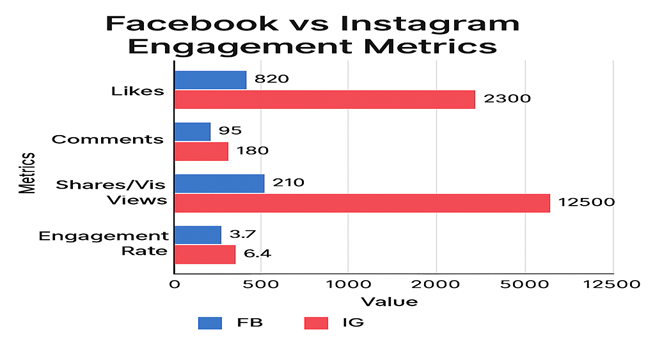
This paper focuses on analyzing interaction with the audience and building an image in PR campaigns on Facebook and Instagram by using a mixed-method approach of comparison. The research missions are to evaluate the effects of platform architecture variations, variations in visual communication styles, and variations in content design on user interaction and the strength of the campaign messages representational power. The quantitative data were gathered containing 120 posts on PR websites (60 on each platform) and examined through both descriptive and inferential statistics analysis to set a comparison between the lines, comments, shares, views, and the rate of engagement. In order to determine thematic patterns corresponding to narrative coherence, symbolic cues and linguistic framing, qualitative visual-discourse analysis was undertaken. These figures demonstrate that Instagram strongly outdoes Facebook in all the engagement indices, with an average of more likes and comments, more visual and general engagement rate. Instagram posts were also more visual, and emotional and Facebook posts were more informational and heavily text based. The above results indicate that Instagram is more capable of serving image-based PR goals, whereas Facebook is beneficial on providing more detailed and context-based messages. The research adds to the knowledge of the cross-platform PR strategy by revealing the necessity of developing platform-specific content. It concludes that PR practitioners must use the differentiated approaches utilizing the advantages of Instagram in visuals and Facebook in information to maximize the communication results.
References
H. Moe, T. Poell, and J. van Dijck, “Rearticulating Audience Engagement,” Television & New Media, vol. 17, no. 2, pp. 99–107, Nov. 2015, doi: 10.1177/1527476415616194.
K. Reuter et al., “General Audience Engagement With Antismoking Public Health Messages Across Multiple Social Media Sites: Comparative Analysis,” JMIR Public Health Surveill, vol. 7, no. 2, p. e24429, Feb. 2021, doi: 10.2196/24429.
S. K. Ernala et al., “Characterizing Audience Engagement and Assessing Its Impact on Social Media Disclosures of Mental Illnesses,” ICWSM, vol. 12, no. 1, June 2018, doi: 10.1609/icwsm.v12i1.15027.
M. Zayani, “Digital Journalism, Social Media Platforms, and Audience Engagement: The Case of AJ+,” Digital Journalism, vol. 9, no. 1, pp. 24–41, Sept. 2020, doi: 10.1080/21670811.2020.1816140.
S. Santos, H. M. Gonçalves, and M. Teles, “Social media engagement and real‐time marketing: Using net‐effects and set‐theoretic approaches to understand audience and content‐related effects,” Psychology and Marketing, vol. 40, no. 3, pp. 497–515, Nov. 2022, doi: 10.1002/mar.21756.
M. Broersma, “Audience Engagement,” The International Encyclopedia of Journalism Studies. Wiley, pp. 1–6, Apr. 29, 2019. doi: 10.1002/9781118841570.iejs0060.
M. Medina, I. Portilla, and T. Pereira, “Questioning Media Audience Engagement for Advertising Purposes and Content Creation,” RCom, vol. 22, no. 2, pp. 339–352, Sept. 2023, doi: 10.26441/rc22.2-2023-3159.
“THE IMAGE OF THE DIGITAL FUTURE: FORMATION IN MEDIA SPACE AND REPRESENTATION IN THE PUBLIC CONSCIOUSNESS,” AST, vol. 19, no. 4, pp. 63–115, 2023, doi: 10.30628/1994-9529-2023-19.4-63-115.
M. Waqar Fazal and M. J. Aslam, “Shaping Public Perception: The Evolution of Government Public Relations in the Digital Age,” SLPR, vol. 2, no. 1, pp. 37–53, May 2023, doi: 10.62585/slpr.v2i1.33.
D. Verčič, A. T. Verčič, and K. Sriramesh, “Looking for digital in public relations,” Public Relations Review, vol. 41, no. 2, pp. 142–152, June 2015, doi: 10.1016/j.pubrev.2014.12.002.
B. Oparaugo, “Role of Public Relations in Corporate Image Building and Sustenance,” IJARBM, vol. 2, no. 1, June 2021, doi: 10.51137/ijarbm.2021.2.1.3.
Mariyo Mariyo, Etika Khairina, Timbul Dompak, and Lubna Salsabila, “The Role of Public Relations in Forming Positive Perception in Society,” ICSSHI, vol. 1, no. 2, pp. 149–162, Jan. 2025, doi: 10.70062/icsshi.v1i2.38.
G. Szondi, “From image management to relationship building: A public relations approach to nation branding,” Place Brand Public Dipl, vol. 6, no. 4, pp. 333–343, Nov. 2010, doi: 10.1057/pb.2010.32.
C. M. Kim, Social Media Campaigns. Routledge, 2020. doi: 10.4324/9781003020196.
S. Prihatmoko and T. Setiyadi, “Enhancing Public Awareness of the Designer Profession: Visual Communication Strategies in Instagram Campaigns,” IJGD, vol. 2, no. 2, pp. 179–194, Nov. 2024, doi: 10.51903/ijgd.v2i2.2113.
M. Bossetta, “The Digital Architectures of Social Media: Comparing Political Campaigning on Facebook, Twitter, Instagram, and Snapchat in the 2016 U.S. Election,” Journalism & Mass Communication Quarterly, vol. 95, no. 2, pp. 471–496, Mar. 2018, doi: 10.1177/1077699018763307.
E. BOZKANAT and P. ASLAN, “Strategic Communication and Social Media within the Context of Media Ecology: A Study on Instagram,” Akdeniz Üniversitesi İletişim Fakültesi Dergisi, no. 39, pp. 94–109, Dec. 2022, doi: 10.31123/akil.1144447.