Factors Influencing the Formation of a Mental Image in the Russian Media
DOI:
https://doi.org/10.51173/ijaa.v1i2.57Keywords:
Mental Imagery, Mass Media, Media Influence, Informational Agenda, Cognitive Representation, Mediated Worldview, Ideological FramingAbstract
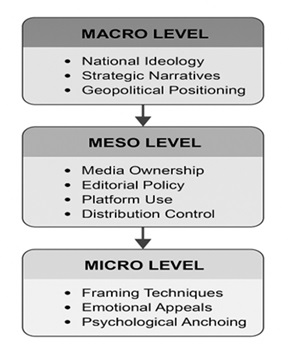
The research identifies a three-tier structure of influence in the formation of mental images: macro-level ideological factors, meso-level institutional mechanisms, and micro-level cognitive framing techniques. The analysis of Russian media narratives, particularly from RT and other state-controlled platforms, revealed a consistent deployment of themes such as national sovereignty, civilizational identity, and external threat. These messages are strategically framed to evoke emotional responses, most notably fear, pride, and moral dualism, thereby reinforcing a cohesive and state-aligned perception of reality. Qualitative content analysis of 30 editorials between 2022 and 2024 demonstrated that national sovereignty (28%), historical continuity (22%), and threat/fear frames (20%) dominate media discourse. Furthermore, semantic network mapping illustrated the repeated co-occurrence of terms such as “Russia”, “values”, “enemies”, and “tradition”, which collectively shape a moral narrative architecture. The findings support the hypothesis that Russian media constructs mental imagery through a coordinated, top-down model of ideological dissemination, institutional control, and cognitive framing. This study offers a multidimensional analytical model that can be applied to other geopolitical media environments with centralized communication systems. Its implications are relevant for media literacy, strategic communication analysis, and international image management studies.
References
Baudrillard, J. (2000). Simulacra and Simulation. Moscow: Dobrosvet.
Kaspersky, R. B. (2012). The Image of the Enemy in Political Communication. Moscow: Aspekt Press.
Leontyev, A. N. (1975). Activity. Consciousness. Personality. Moscow: Politizdat.
Savchenko, M. V. (2017). Formation of Mental Images in the Modern Media Space. Tomsk State University Bulletin.
Shestopal, E. B., & Shestopal, A. V. (2013). Political Imageology: Theory and Practice of Forming the Image of a Political Subject. Moscow: Aspekt Press.
Koide-Majima, N., Nishimoto, S., & Majima, K. (2024). Mental Image Reconstruction from Human Brain Activity: Neural Decoding of Mental Imagery via Deep Neural Network-Based Bayesian Estimation. Neural Networks.
A. F. Radwan, "Is it time to develop government communication functions?" Journal of Media Researcher, vol. 15, no. 60, pp. 1-6, 2023, doi: 10.33282/abaa.v15i60.1083.
A. S. Hamood, “Cross-cultural Miscommunication: Effects on ESOL learners and Sequences for ESOL Teachers,” J. Iraqia Univ., vol. 62, no. 1, pp. 630-633, 2023. [Online]. Available: https://www.iasj.net/iasj/issue/16589.
Kosslyn, S. M. (1980). Image and Mind. Cambridge, MA: Harvard University Press. 464 p.
Nisbett, R. E. (2003). The Geography of Thought: How Asians and Westerners Think Differently... and Why. New York: Free Press.
Pylyshyn, Z. W. (2003). Mental Imagery: In Search of a Theory. Behavioral and Brain Sciences, 25(2), 157-238.
L. H. Mohammed and A. S. Hamood, "Impoliteness Strategies and Politeness Maxims Violation in the Retweets on Selected Posts of the U.S. Secretary of State Michael Pompeo," Iklīl for Humanities Studies, vol. 4, no. 3 ج3, pp. 1701-1725, 2023. [Online]. Available: https://www.iasj.net/iasj/article/285016.
M. A. F. Al-Hasani, "Media policy and its impact on the level of objectivity in the Iraqi media: A study from the communicators’ point of view in the Iraqi media outlets for the period from (1/5/2021 to 1/9/2021)," Journal of Media Researcher, vol. 15, no. 59, pp. 81-101, 2023, doi: 10.33282/abaa.v15i59.954.
Sontag, S. (1977). On Photography. New York: Farrar, Straus and Giroux.